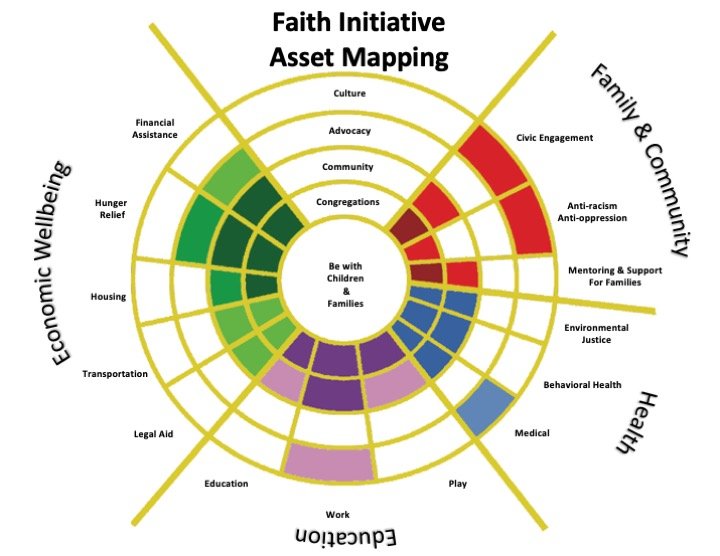
Asset Map of congregational ministries across 20 congregations in partnership with the Faith Initiative
What We Are Doing
The Faith Initiative has developed five program areas -- housing, education, immigration, mental health, and neighborhoods -- to end child poverty in Spartanburg County. We implement our five-tiered strategy (be with children and their families; develop congregational ministries; align with community efforts; advocacy; and shift culture) through each of the five program areas:
1. Housing: Housing and homelessness are major issues here. Approximately 27 people/day move to Spartanburg County. Pressures on the housing market are intensifying. Additionally, 1,200 children are identified as homeless in Spartanburg County through our public school McKinney-Vento count.
Three years ago, Spartanburg County had lost its two family shelters. After presenting to our congregations a community-wide plan to address housing and homelessness led by seven institutional partners, our congregations asserted the desire to revive a family shelter program through congregations.
Today, 22 congregations in partnership with A Place To Call Home, our community-wide coalition to address housing and homelessness, maintain a family shelter that has resourced more than 70 families and has helped more than a dozen families stabilize work and housing. We also know that no family shelter will serve all 1,200 unhoused children here. Through this partnership, congregations are engaging in advocacy for systems level change at the county and state levels. That combination of effective direct service linked with active awareness of the need for larger scale transformation is a major step forward for our community.
2. Mental Health: Rev. Dr. Mekeshia Bates leads an innovative program to increase access to and decrease stigma of mental health services in the Black community through Black congregations. Two leading Black congregations, Mt. Moriah Baptist Church and Macedonia Missionary Baptist Church, joined with the Faith Initiative as partners to pilot this program. Through trainings, preaching and teaching, direct therapeutic services, and advocacy, the program has served more than 1,000 individuals and is engaging with multiple congregations beyond the two pilot churches across the county and region.
3. Neighborhoods: We asked one of our major institutional partners, the Spartanburg Academic Movement, to use their indicators of economic mobility to identify the ten census tracts in our county with the highest child poverty rates. Mayo, a rural township in the northern part of the county, surprised everyone reviewing the research with a 100% child poverty rate, the highest in the county.
To learn about the community, we began meeting with congregations in the area, Mayo Elementary School, and school district administrators. The major breakthrough came when the Faith Initative shared this data with a group of highly organized, highly motivated church volunteers. This dynamic team took the lead on convening meetings and began seeking funding to provide direct support. Now more than $30,000 of direct support and much more in-kind resourcing has flowed from congregations and institutional partners through the elementary school to families, including a mobile health unit coming to an area with no medical services.
4. Culture: The fifth tier of our strategy, culture, is about helping our community shift from a culture of separation for exploitation to a culture of connection and sharing, based on both theology and the economics research of Raj Chetty. Culture is how we live together. When the Faith Initiative convenes congregations to fellowship and engage in learning and dialogue, we are shifting from a culture of separation to one of connection. The quantifiable result has been an increase from 5 congregations working together at our inception to now more than 50 congregations in partnership, and an initial network of 175 participants to now more than 700 people engaged.